Introduction
Artificial Intelligence has become one of the most influential technologies in modern business. From content creation tools and chatbots to predictive analytics platforms, companies are actively exploring ways to use AI to improve efficiency and drive growth.
However, many businesses are still using AI only as a productivity tool. They generate content, automate repetitive tasks, or create reports faster than before. While these applications are valuable, they represent only a small portion of AI's true potential.personalized experiences
The real transformation is being driven by AI Agents.
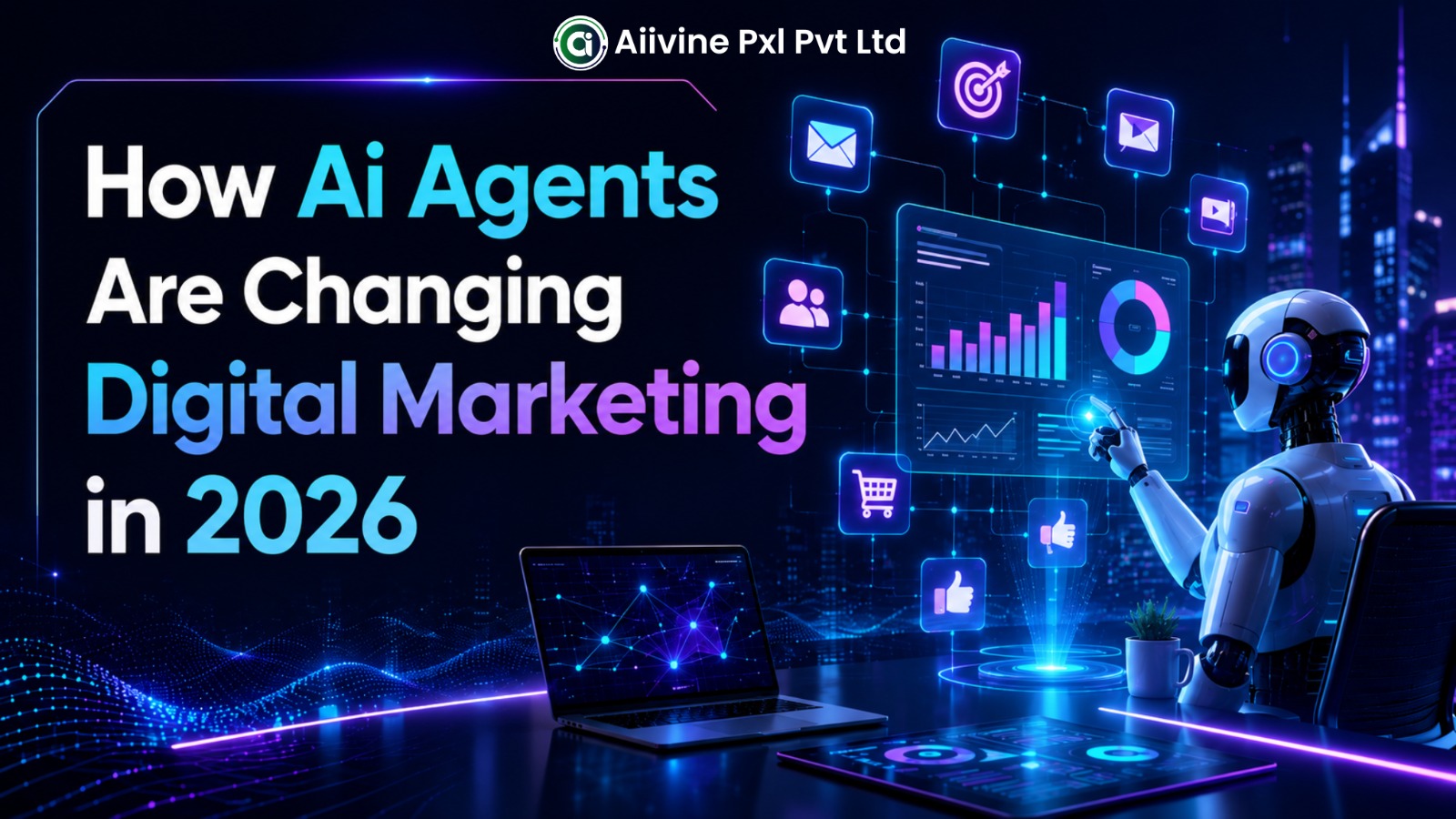
Unlike traditional AI tools that require continuous human instructions, AI Agents can independently analyze information, make decisions, execute actions, and optimize outcomes based on specific business goals. They function more like intelligent digital team members than software tools.
For marketers, this shift is creating entirely new opportunities to improve customer engagement, increase lead conversions, optimize advertising campaigns, and deliver personalized experiences at scale.
In this article, we'll explore how AI Agents are changing digital marketing and why businesses that adopt them early are gaining a significant competitive advantage.
What Are AI Agents?
An AI Agent is an intelligent software system designed to perform tasks autonomously while working toward a specific objective.
Traditional automation relies on predefined rules.
For example:
- If a user submits a form, send an email.
- If a customer abandons a cart, send a reminder.
- If a lead reaches a score threshold, notify sales.
AI Agents take automation several steps further.
They can:
- Understand goals
- Analyze customer behavior
- Create action plans
- Make data-driven decisions
- Learn from outcomes
- Continuously improve performance
Instead of simply following instructions, AI Agents actively work to achieve business objectives.
For example, rather than sending the same follow-up email to every lead, an AI Agent can determine the best time to contact a prospect, personalize the message, monitor engagement, and optimize future communication based on results.
AI Agents vs Traditional AI Tools
Many businesses confuse AI Agents with standard AI software.
Traditional AI tools are task-oriented. They perform specific actions when instructed.
Examples include:
- Writing content
- Creating images
- Generating reports
- Producing social media captions
Once the task is completed, the process ends.
AI Agents operate differently.
They are goal-oriented rather than task-oriented.
AI Agents can:
- Execute multiple actions independently
- Monitor performance continuously
- Adapt strategies based on outcomes
- Operate across multiple platforms
- Optimize processes without constant supervision
This ability to think, act, and improve makes AI Agents particularly valuable for digital marketing.
Hyper-Personalization at Scale
Personalization has become one of the most important factors influencing customer engagement.
Modern consumers expect brands to understand their preferences and deliver relevant experiences.
Many businesses still rely on broad audience segments such as:
- New customers
- Returning customers
- Newsletter subscribers
- High-value customers
While segmentation helps, it does not create truly personalized experiences.
AI Agents analyze large amounts of customer data, including:
- Browsing history
- Purchase behavior
- Website interactions
- Email engagement
- Content preferences
Using these insights, they can deliver highly relevant messages tailored to individual users.
Benefits of AI-powered personalization include:
- Higher engagement rates
- Improved customer experience
- Increased conversions
- Better customer retention
- Stronger brand loyalty
Customers are far more likely to interact with brands that provide relevant and timely communication.
Smarter Content Creation and SEO
Content marketing remains a critical component of digital marketing success.
However, consistently producing high-quality content requires significant time, research, and effort.
AI Agents help streamline the entire content marketing process.
They can:
- Identify trending topics
- Conduct keyword research
- Analyze competitors
- Create content briefs
- Generate draft content
- Optimize articles for SEO
- Repurpose content across channels
- Track content performance
For marketing teams, this means spending less time on repetitive tasks and more time focusing on strategy, creativity, and audience engagement.
It's important to remember that AI Agents do not replace human creativity. The most successful organizations combine human expertise with AI-driven efficiency.
When marketers provide strategic direction and AI Agents handle execution and optimization, businesses achieve better results faster.
AI-Powered Lead Generation and Follow-Up
Lead generation is only valuable if businesses can engage prospects quickly.
Studies consistently show that faster response times lead to higher conversion rates.
Unfortunately, many organizations still take hours or even days to respond to inquiries.
AI Agents solve this problem by engaging prospects instantly.
When a lead enters the sales funnel, an AI Agent can:
- Respond immediately
- Ask qualification questions
- Gather relevant information
- Recommend solutions
- Schedule appointments
- Route qualified leads to sales teams
This creates a seamless customer experience while ensuring that no opportunity is missed.
Key benefits include:
- Faster response times
- Better lead qualification
- Higher conversion rates
- Increased customer satisfaction
- Reduced workload for sales teams
For businesses competing in crowded markets, immediate engagement can be the difference between winning and losing a customer.
Real-Time Campaign Optimization
Digital advertising requires continuous monitoring and optimization.
Businesses invest heavily in platforms such as:
- Google Ads
- Meta Ads
- LinkedIn Ads
- YouTube Ads
The challenge is that campaign performance can change rapidly.
Many marketing teams review performance daily or weekly, which can result in missed opportunities and wasted ad spend.
AI Agents continuously monitor important metrics, including:
- Cost per click (CPC)
- Click-through rates (CTR)
- Conversion rates
- Audience engagement
- Budget utilization
When performance changes, AI Agents can automatically:
- Reallocate budgets
- Pause underperforming ads
- Scale successful campaigns
- Adjust bidding strategies
- Test new creative variations
This real-time optimization helps businesses maximize return on investment while reducing unnecessary spending.
Benefits of AI Agents for Businesses
Organizations that implement AI Agents effectively often experience measurable improvements across multiple areas of marketing.
Some of the biggest advantages include:
- Increased operational efficiency
- Better customer experiences
- Improved lead conversion rates
- Reduced manual workloads
- Enhanced decision-making
- More accurate marketing insights
- Higher return on marketing investment
Because AI Agents can process large amounts of data quickly and work continuously, they help businesses scale marketing efforts without significantly increasing costs.
How Businesses Can Start Using AI Agents
Implementing AI Agents does not require transforming every business process overnight.
The most successful approach is to start small and scale gradually.
Businesses should begin by:
Build a Strong Data Foundation
Ensure CRM systems, analytics tools, and customer databases are accurate and up to date.
Define Clear Objectives
Set measurable goals such as:
- Increase qualified leads by 20%
- Improve email open rates by 25%
- Reduce customer acquisition costs
Start with One Process
Focus on areas such as:
- Lead qualification
- Email automation
- Customer support
- Reporting and analytics
Maintain Human Oversight
AI Agents should support strategic decision-making, not replace human expertise.
Human review remains essential for brand messaging, customer relationships, and long-term business strategy.
The Future of AI Agents in Digital Marketing
AI Agent adoption is expected to accelerate significantly over the next few years.
Future developments may include:
- Fully autonomous marketing workflows
- Advanced predictive customer journeys
- Real-time omnichannel optimization
- AI-powered sales and marketing alignment
- Hyper-personalized customer experiences
As technology continues to evolve, businesses that invest early will gain valuable experience, operational efficiencies, and competitive advantages.
Organizations that delay adoption may find it increasingly difficult to keep pace with competitors that leverage AI-driven marketing systems.
Conclusion
AI Agents are redefining what is possible in digital marketing.
From personalized customer experiences and automated lead nurturing to content creation and real-time campaign optimization, these intelligent systems enable businesses to operate faster, smarter, and more efficiently.
Rather than replacing marketers, AI Agents enhance human capabilities by handling repetitive tasks, analyzing complex datasets, and continuously optimizing performance.
The future of digital marketing belongs to organizations that successfully combine human creativity, strategic thinking, and AI-powered execution.
Businesses that begin adopting AI Agents today will be better positioned to generate more leads, improve conversions, enhance customer experiences, and maintain a competitive advantage in an increasingly digital world.
FAQs :
1. What are AI Agents in digital marketing?
AI Agents are intelligent systems that can autonomously analyze data, make decisions, execute marketing activities, and optimize results to achieve specific business goals.
2. How do AI Agents improve lead generation?
AI Agents can instantly engage prospects, qualify leads, personalize communication, and schedule follow-ups, leading to higher conversion rates.
3. Are AI Agents replacing digital marketers?
No. AI Agents handle repetitive and data-intensive tasks, while marketers focus on strategy, creativity, customer relationships, and business growth.
4. Can small businesses benefit from AI Agents?
Yes. Small businesses can use AI Agents to automate marketing processes, improve customer engagement, and compete more effectively without increasing headcount.
5. Which industries can benefit from AI Agents?
Almost every industry can benefit, including healthcare, education, manufacturing, real estate, finance, retail, technology, and professional services.