A Complete Guide for High-Growth Businesses in 2026
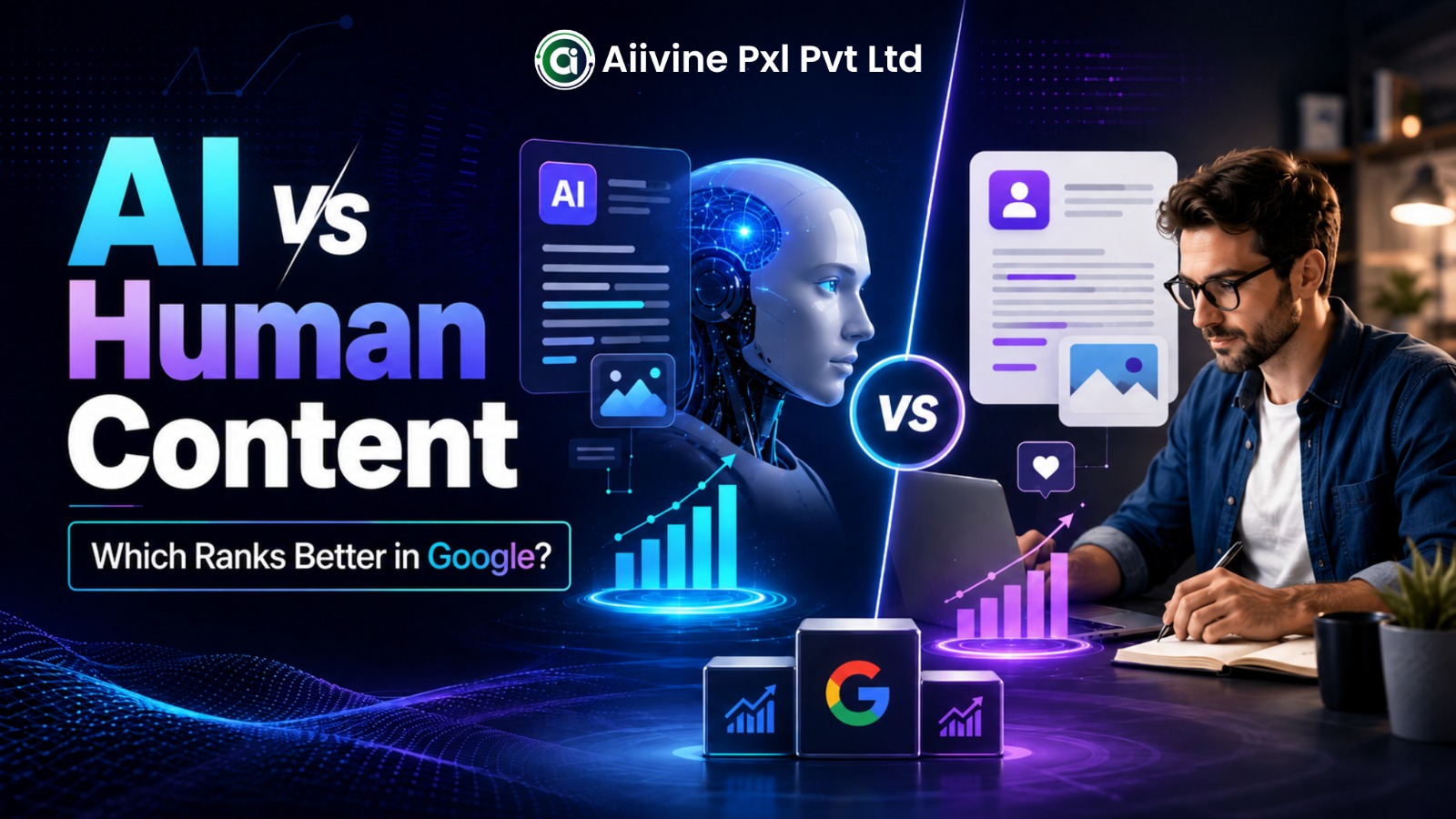
In the era of Artificial Intelligence, content creation has undergone a massive transformation. Businesses today can generate blogs, product descriptions, and marketing copy within seconds using AI tools. But a critical question remains:
Does AI content rank better than human content in Google?
For large enterprises and high-revenue companies, the stakes are even higher. Your website content is not just about traffic — it's about brand authority, lead generation, and revenue growth.
In this comprehensive guide, we’ll explore the truth behind AI vs human content, how Google evaluates content in 2026, and what strategy works best for businesses targeting competitive markets.
Understanding How Google Ranks Content in 2026
Before comparing AI and human content, it’s important to understand one key fact:
Google does not rank content based on who wrote it. Google ranks content based on quality, relevance, and usefulness.
Google’s ranking system focuses on:
Content Quality
User Experience
Expertise and Authority
Originality
Search Intent Matching
Engagement Signals
Trustworthiness
E-E-A-T
Experience
Expertise
Authoritativeness
Trustworthiness
What is AI Content?
AI content refers to any form of written, visual, audio, or video material created using Artificial Intelligence tools instead of being produced entirely by humans. These tools use advanced algorithms and machine learning models to understand language patterns, analyze data, and generate content that closely resembles human-created work.
In simple terms, AI content is content generated by software that can think, learn, and write based on data it has been trained on.
Today, AI content has become a major part of digital marketing, SEO, and online business strategies because it allows companies to create high-quality content quickly, consistently, and at scale.
How AI Content Works
AI content is generated using technologies such as:
- Natural Language Processing (NLP)
- Machine Learning (ML)
- Large Language Models (LLMs)
- Data Pattern Recognition
These technologies enable AI tools to:
- Understand user queries
- Predict relevant words and phrases
- Generate meaningful sentences
- Structure content logically
For example, when a user enters a topic like:
"Benefits of Digital Marketing for Small Businesses"
An AI system can instantly analyze millions of similar articles, identify key themes, and produce a structured blog post within seconds.
For Example:
- SEO Content
- Website Content
- Blog Write
- Social Media Content
- E-mail Marketing Content
Popular AI Tools Used for Content Creation:
ChatGPT
Google Gemini
Claude
What is Human Content?
Human content refers to any type of content that is created, written, or produced by a real person using their own knowledge, experience, creativity, and understanding of a subject. Unlike AI-generated content, human content is shaped by personal insights, real-world experiences, emotions, and critical thinking.
In a blog perspective, human content is content that reflects genuine expertise and human judgment, making it more relatable, trustworthy, and meaningful for readers. It is often considered the foundation of authoritative content, especially in industries where credibility and trust are essential.
In today’s digital world, businesses rely heavily on content to connect with customers, build brand authority, and improve search engine rankings. While Artificial Intelligence has made content creation faster, human content still plays a crucial role because it brings depth, originality, and authenticity that machines cannot fully replicate.
Human content is typically created by:
Professional writers
Industry experts
Business owners
Marketers
Subject matter specialists
Researchers and consultants
These individuals use their expertise and real-life experiences to create content that provides value, solves problems, and builds trust with audiences.
For Example:
Blog Articles
Case Studies
Thought Leadership Content
Website Content
Difference Between Human Content vs AI Content
Aspect | Human Content | AI Content |
| Definition | Content created by humans using personal knowledge, creativity, and real-life experience | Content generated by Artificial Intelligence using algorithms and data patterns |
| Creator | Writers,experts, marketers, business professionals | AI tools and software like ChatGPT, Gemini, Jasper, etc. |
| Cost | Higher cost due to human effort and expertise | Lower cost because automation reduces labor expenses |
| SEO Performance | Strong for authority-based and expert content | Good for producing large volumes of SEO content |
| Consistency | May vary depending on the writer | Highly consistent in tone and structure |
| Scalability | Limited humans can produce only a certain amount of content | Highly scalable — can generate large amounts of content quickly |
| Originality | Highly original and unique | Sometimes repetitive or similar to other content |
| Decision-Making Ability | Can analyze complex situations and make judgments | Follows predefined patterns and rules |
| Adaptability | Flexible and able to adjust based on feedback and new information | Requires updates or retraining to adapt to changes |
| Trust and Credibility | Builds stronger trust and brand authority | Trust depends on quality control and human review |
| Risk Level | Low risk when created by professionals | Medium risk if content is not fact-checked |
| Future Role | Essential for authority and strategic content | Essential for automation and productivity |
AI + Human Hybrid Content Model
AI-only content often performs:
Fast indexing
Moderate rankings
Lower engagement
Human-edited content performs:
Higher rankings
Better engagement
More backlinks
Higher conversions
The best performing content strategy is:
AI + Human Hybrid Content
AI for speed
Humans for quality
This combination delivers:
- Faster production
- Better SEO
- Higher authority
- Stronger brand trust
How Enterprise Businesses Should Use AI Content
Artificial Intelligence (AI) has become a powerful tool for enterprise businesses looking to scale their marketing, improve efficiency, and stay competitive in digital markets. However, simply using AI to generate content is not enough. Large organizations must adopt a structured and strategic approach to ensure AI content supports brand authority, SEO performance, and business growth.
Enterprise companies — especially those with large customer bases, global operations, or high revenue targets — need content that is fast, accurate, consistent, and trustworthy. When used correctly, AI content can help enterprises produce high-quality content at scale while maintaining strong brand standards.
Why AI Content Matters for Enterprise Businesses:
Enterprise organizations manage large volumes of content across multiple platforms, including:
Corporate websites
Blogs and knowledge bases
Product catalogs
Customer support documentation
Marketing campaigns
Social media channels
Creating all this content manually can be time-consuming and expensive. AI helps enterprises:
Produce content faster
Reduce operational costs
Maintain consistency
Scale marketing efforts
Improve SEO performance
But the key is not just using AI, it is using AI strategically.
Future of AI Content in Enterprise Businesses:
AI will continue to evolve and become more advanced. In the coming years, enterprise businesses will use AI for:
Predictive content creation
Real-time personalization
Automated customer communication
Data-driven marketing strategies
However, human expertise will remain essential for strategic thinking, creativity, and decision-making.
The Future: The "Google-Defined" Content
We are currently in the third wave of the AI content war.
Wave 1 (2023): Spam. Copy-paste ChatGPT. Google penalized it.
Wave 2 (2024-2025): Polishing. AI writes, human edits. Google accepted it.
Wave 3 (2026): Orchestration.
Today, the highest-ranking content is neither "pure human" nor "pure AI." It is "Google-Defined" content.